Server-side measurement (server-side tracking) moves data collection from the visitor's browser to a server you control, which then forwards events to tools such as GA4, the Meta Conversions API and Google Ads enhanced conversions. It recovers some of the conversions that ad blockers and browser tracking prevention hide from client-side tags, but it still needs user consent and adds setup and hosting costs.
Data accuracy is more critical than ever. With increasing privacy regulations, browser restrictions on cookies, and growing concerns about data security, traditional client-side tracking methods are becoming less reliable. As a result, businesses are turning to server-side measurement to gain more control over their data collection processes and ensure precise, privacy-compliant analytics.
Server-side measurement shifts data collection from the user’s browser to a secure cloud-based environment, allowing marketers to bypass tracking limitations, improve data enrichment, and enhance attribution accuracy. By implementing server-side tracking, brands can ensure they are making data-driven marketing decisions based on clean, reliable, and future-proof insights.
What is server-side measurement?
Server-side measurement is a modern tracking method that moves data collection and processing from the client’s browser to a secure server environment. Unlike traditional client-side tracking, which relies on cookies and scripts running in a user’s browser, server-side tracking processes data on a brand’s own server before sending it to analytics and ad platforms.
With privacy regulations tightening and browser tracking restrictions increasing, businesses need a more reliable and secure way to track user behavior while maintaining compliance. Server-side measurement offers greater control over data collection, improved accuracy, and better security, making it a future-proof solution for digital marketing analytics.
Key Features of Server-Side Measurement
Data Accuracy: Reduces data lost to browser limitations and ad blockers, though it cannot recover events from users who decline consent.
Privacy Compliance – Enables businesses to manage GDPR and CCPA compliance by filtering out sensitive data before sending it to third parties.
Better Control Over Data – Allows brands to customize what data is collected and shared, reducing exposure to unauthorized third parties.
First-Party Data Optimization – Strengthens first-party data strategies, helping businesses adapt to a cookieless digital environment.
Server-side measurement is rapidly becoming the preferred tracking method for businesses seeking more accurate marketing insights and future-proofed analytics.
Why does server-side tracking matter?
The digital marketing landscape is shifting toward stricter privacy regulations, increased browser tracking restrictions, and the decline of third-party cookies. As a result, traditional client-side tracking is becoming unreliable, leading to data loss, inaccurate attribution, and compliance risks. Server-side tracking provides a future-proof solution by offering better data accuracy, stronger privacy compliance, and enhanced marketing performance.
Improving Data Accuracy
Client-side tracking is often affected by ad blockers, tracking prevention mechanisms, and browser cookie restrictions, which can cause incomplete or missing data in analytics reports. Server-side tracking mitigates these issues by:
Collecting data in a controlled environment, unaffected by browser limitations.
Filtering out bot traffic and duplicate events for more precise reporting.
Navigating Privacy Regulations
Laws like GDPR and CCPA, and Apple's App Tracking Transparency (ATT) framework on iOS, require businesses to handle user data responsibly. Client-side tracking often exposes user data to third parties, making compliance challenging. Server-side tracking helps by:
Processing user data on a secure server before sharing it externally.
Anonymizing and filtering sensitive information to meet privacy standards.
Overcoming Browser Tracking Restrictions
Browsers like Safari (ITP) and Firefox (ETP) limit third-party tracking by default, making traditional tracking less effective. Server-side tracking:
Relies on first-party data, bypassing third-party cookie restrictions.
Reduces reliance on JavaScript-based scripts, which can be blocked by browsers.
Keeps more events intact when browsers tighten their privacy settings.
Enhancing Marketing and Ad Performance
Marketing platforms like Google Ads, Meta, and TikTok rely on data to optimize campaign performance. Without accurate tracking, ad targeting and attribution suffer. Server-side tracking improves marketing results by:
Providing enriched conversion data for better audience segmentation.
Reducing discrepancies in attribution models, ensuring accurate ad spend analysis.
Optimizing remarketing strategies by ensuring reliable event tracking.
As the digital ecosystem moves toward cookieless tracking and privacy-first marketing, server-side measurement has become essential for businesses looking to maintain data accuracy, comply with regulations, and improve marketing efficiency. (marketing budget optimization)
What is happening to third-party cookies?
The digital advertising industry is undergoing a major shift as third-party cookies—once the backbone of online tracking—are being phased out. This shift, often referred to as the "cookie apocalypse," is driven by privacy regulations, browser restrictions, and increasing consumer demand for data protection.
What is the Cookie Apocalypse?
For years, businesses have relied on third-party cookies to track users across websites, enabling precise ad targeting, remarketing, and attribution modeling. However, with growing concerns over data privacy, major browsers and regulators are restricting or eliminating third-party cookies altogether.
Safari (Intelligent Tracking Prevention - ITP) and Firefox (Enhanced Tracking Protection - ETP) already block third-party cookies by default.
Google Chrome, the most widely used browser, still allows third-party cookies by default: Google cancelled its plan to phase them out in 2024 and dropped the planned user-choice prompt in 2025.
GDPR and CCPA regulations are tightening restrictions on how businesses collect and use consumer data.
These changes mean that businesses can no longer depend on third-party cookies for tracking, targeting, and measuring ad performance.
How the End of Third-Party Cookies Affects Marketing
Without third-party cookies, businesses face challenges such as:
Limited cross-site tracking – Brands can no longer track users across different websites.
Weakened ad targeting and personalization – Retargeting and behavioral-based advertising become less effective.
Inaccurate attribution – Marketers struggle to determine which channels drive conversions.
As a result, brands must shift to first-party data strategies and alternative tracking methods to continue delivering personalized experiences and measuring campaign effectiveness.
How Server-Side Measurement Solves the Cookie Problem
Server-side tracking helps businesses adapt to the post-cookie world by collecting first-party data directly and sending it securely to marketing and analytics platforms.
Uses first-party data instead of relying on third-party cookies.
Works across browsers, even those with strict privacy policies.
Strengthens data control and compliance, ensuring adherence to GDPR, CCPA, and other regulations.
As Safari, Firefox and ad blockers keep restricting browser-based tracking, businesses that invest in server-side tracking keep more of their measurement intact.
How Does Server-Side Tracking Work?
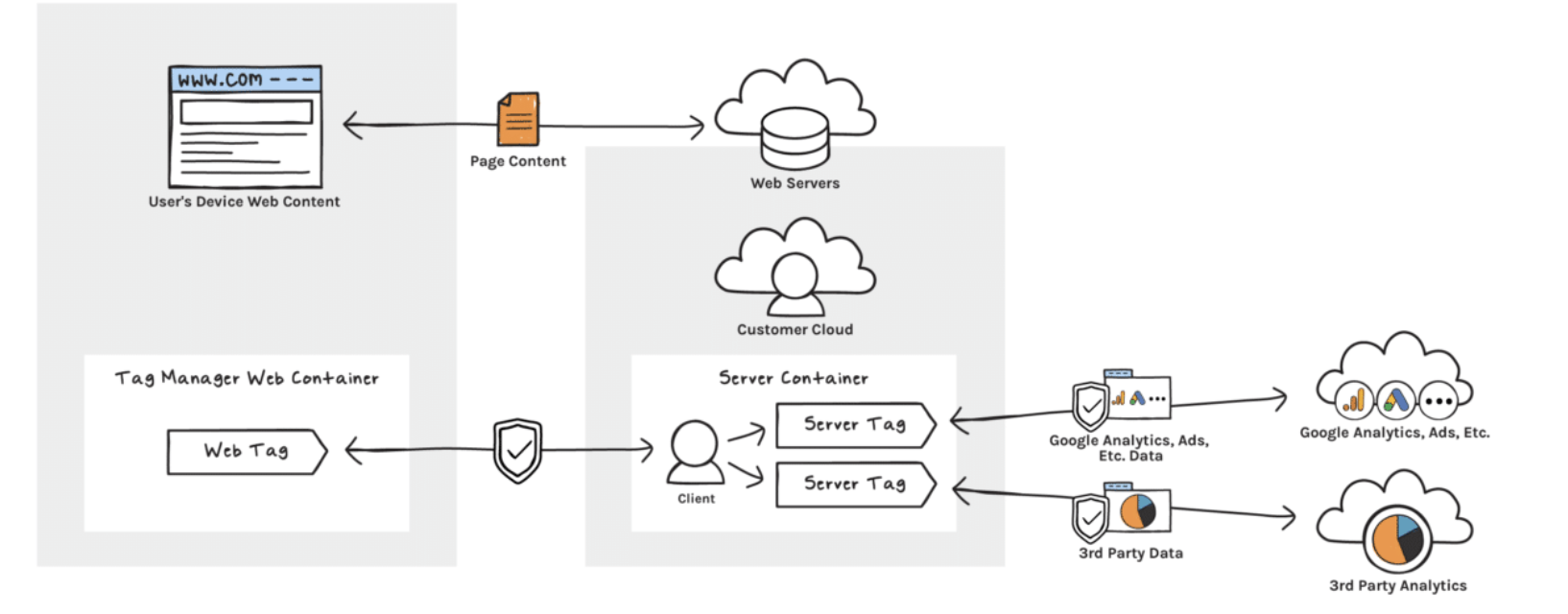
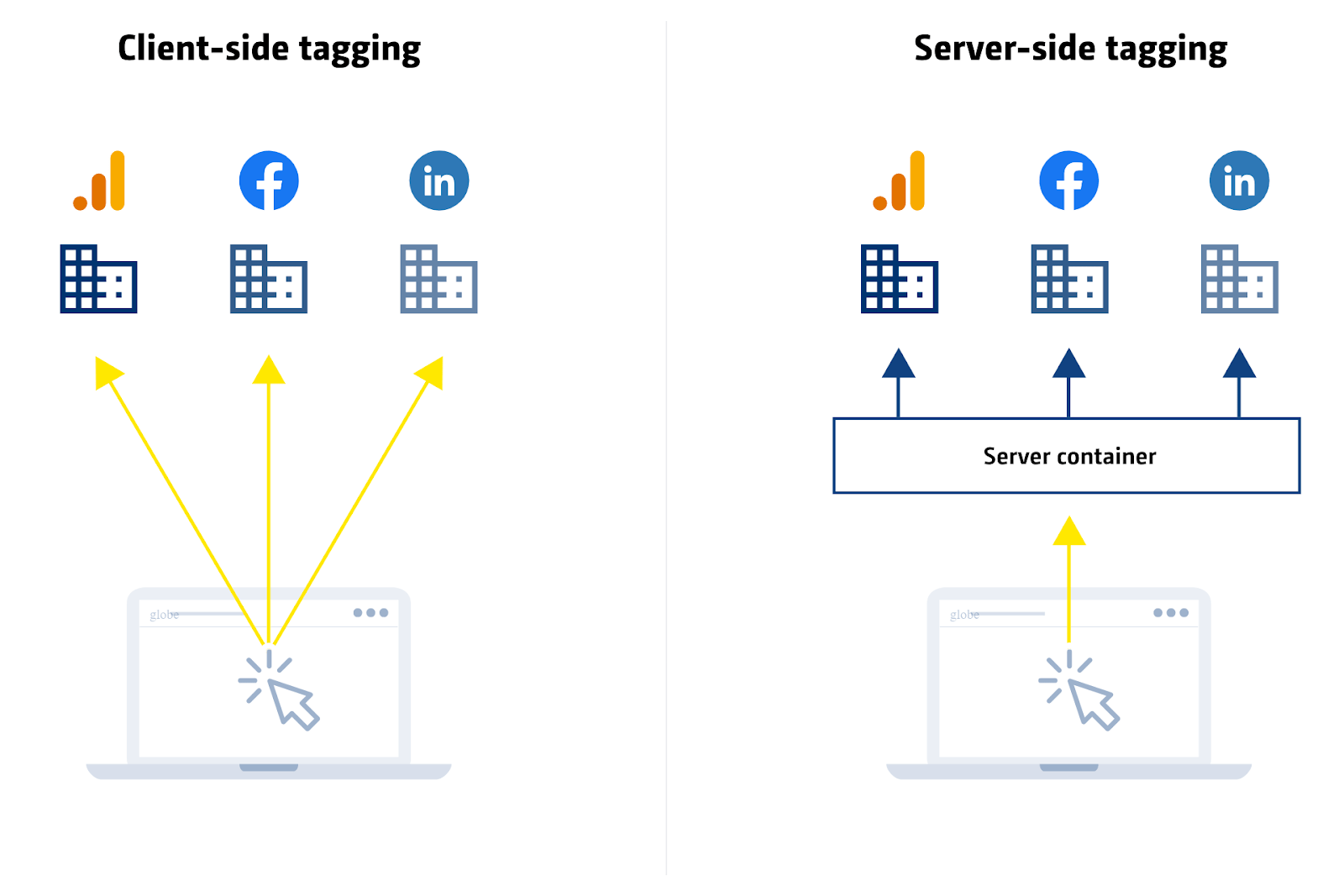
Server-side tracking shifts data collection and processing from the user’s browser to a secure server, ensuring better accuracy, privacy compliance, and data control. Instead of sending tracking data directly from the browser to analytics and marketing platforms, server-side tracking processes data in a controlled environment before forwarding it externally.
How Server-Side Tracking Works: Step-by-Step
User Interaction – A visitor browses a website, clicks on an ad, or completes a purchase.
Data Sent to the Server – Instead of tracking data in the browser, events are forwarded to a secure server.
Data Processing and Enrichment – The server cleans, validates, and enhances data, removing duplicates and filtering out bot traffic.
Privacy Controls Applied – The server anonymizes or removes sensitive user data, ensuring compliance with GDPR, CCPA, and privacy laws.
Data Forwarded to Analytics and Marketing Platforms – The processed data is then sent to tools like Google Analytics, Meta Ads, TikTok, and CRM systems.
Client-Side vs. Server-Side Tracking
Traditional client-side tracking collects data directly in the browser using JavaScript tags and cookies, but this method faces challenges due to ad blockers, browser privacy settings, and third-party cookie deprecation.
In contrast, server-side tracking:
Processes data in a controlled environment, unaffected by browser restrictions.
Reduces reliance on third-party cookies, enabling a shift toward first-party data strategies.
Prevents data loss caused by tracking prevention mechanisms and ad blockers.
Cloud-Based vs. On-Premise Server-Side Tracking
Businesses can implement server-side tracking using either cloud-based services or on-premise solutions.
Cloud-Based Tracking (e.g., Google Tag Manager Server-Side) – Runs on platforms like Google Cloud or AWS, providing a scalable, managed environment for data processing.
On-Premise Tracking – Requires companies to host their own tracking servers, offering greater control and security but requiring more IT resources.
Integration with Marketing and Analytics Platforms
Server-side tracking integrates with major marketing tools:
Google Analytics 4 (GA4) – Improves first-party data collection and attribution.
Meta Conversions API (CAPI) – Enables direct conversion tracking without relying on browser signals.
Google Ads Enhanced Conversions – Strengthens conversion tracking accuracy.
CRM and CDPs – Connects with Salesforce, HubSpot, and Segment for personalized marketing campaigns.
By shifting tracking responsibilities from client-side to server-side, businesses can overcome browser restrictions, enhance data privacy, and improve marketing measurement. This future-proof approach ensures that brands maintain data integrity while complying with evolving privacy laws.
What are the benefits of server-side measurement?
Server-side measurement enhances data accuracy, privacy compliance, and marketing performance, making it an essential tool for businesses navigating cookie restrictions and evolving privacy regulations. By shifting data processing from the browser to a secure server, businesses gain greater control over their analytics, ad tracking, and customer insights.
Improved Data Accuracy
Client-side tracking is increasingly unreliable due to ad blockers, browser tracking prevention, and cookie restrictions, leading to missing or incomplete data. Server-side measurement ensures that data is processed, cleaned, and standardized before being sent to analytics and ad platforms.
Minimizes data loss caused by tracking prevention mechanisms in Safari (ITP) and Firefox (ETP).
Reduces duplicate and bot-generated events, ensuring cleaner datasets.
Ensures accurate conversion tracking by forwarding events securely from a controlled server environment.
Enhanced Privacy Compliance
With regulations like GDPR and CCPA, and Apple's App Tracking Transparency (ATT) framework on iOS, businesses must ensure that user data is collected responsibly. Server-side measurement allows companies to filter, anonymize, and control data before sharing it with third parties, ensuring compliance while maintaining valuable insights.
Protects user privacy by storing and processing data securely before sharing.
Ensures GDPR and CCPA compliance by managing consent-based data collection.
Gives businesses full control over what data is sent to external platforms.
Better Data Enrichment and Security
Unlike client-side tracking, which captures raw, unprocessed data, server-side measurement allows businesses to enhance, clean, and structure their data before forwarding it to analytics platforms.
Combines first-party data with CRM and CDP insights, creating richer customer profiles.
Filters out bad data (e.g., bot traffic, duplicate conversions) for more reliable analytics.
Secures sensitive information by processing data within a private, controlled server.
Optimized Marketing and Ad Performance
Accurate tracking is essential for ad performance, audience targeting, and conversion optimization. Server-side tracking improves data sharing with advertising platforms, ensuring that campaigns are measured and optimized effectively.
Enables more precise retargeting by sending reliable first-party data to ad platforms.
Can improve ad platform optimization, because Meta and Google Ads receive more of the conversions that actually happened.
Reduced Dependency on Third-Party Cookies
With third-party cookies disappearing, businesses must rely on first-party data for tracking and audience segmentation. Server-side measurement supports this shift by:
Collecting data through first-party cookies, ensuring long-term tracking resilience.
Reducing reliance on external data providers, making marketing efforts more sustainable.
Providing accurate insights even as browsers restrict third-party tracking.
Faster Website Performance and Improved User Experience
Traditional tracking methods often rely on multiple third-party scripts, slowing down website performance. Server-side tracking reduces browser load times by offloading tracking requests to a secure server.
Removes unnecessary third-party scripts, improving page speed.
Reduces browser CPU usage, leading to smoother interactions on mobile.
Server-side measurement offers superior data accuracy, stronger privacy compliance, and optimized marketing performance compared to traditional tracking. By reducing data loss, improving attribution, and securing sensitive information, businesses can future-proof their analytics while maintaining trust and compliance in a privacy-first world.
How do you implement server-side measurement?
Transitioning to server-side measurement requires careful planning, technical setup, and strategic execution. Businesses need to ensure data accuracy, compliance, and working integrations with marketing and analytics platforms. Below are the essential steps to implement server-side tracking effectively.
Define Your Tracking Goals and Data Needs
Before setting up server-side tracking, businesses must determine what data they need to collect and how it will be used.
Identify key events to track (e.g., page views, conversions, form submissions, purchases).
Determine which platforms will receive the processed data (Google Analytics 4, Meta Ads, Google Ads, CRM systems).
Assess privacy and compliance requirements to ensure GDPR, CCPA, and other regulatory standards are met.
Choose a Server-Side Tracking Solution
Businesses can implement server-side tracking using cloud-based or on-premise solutions.
Cloud-Based Server-Side Tracking: Services like Google Tag Manager Server-Side (sGTM), AWS Lambda, or Cloudflare Workers allow businesses to process tracking events in a managed cloud environment, reducing infrastructure complexity.
On-Premise Server-Side Tracking: Companies with strict data security policies may choose to host tracking servers internally, giving them full control over data storage and processing. This approach requires dedicated IT resources for server maintenance.
Set Up a Server-Side Container (Google Tag Manager Example)
For businesses using Google Tag Manager Server-Side (sGTM), the setup process involves:
Creating a new GTM Server-Side container in Google Tag Manager.
Deploying a cloud instance (Google Cloud, AWS, or another hosting provider).
Configuring DNS settings to ensure tracking requests are processed through a custom subdomain
Enabling client-side tagging to forward tracking events to the server.
Filter and Process Data Securely
Unlike client-side tracking, where raw data is sent directly to third-party platforms, server-side tracking enables data cleaning, filtering, and processing before transmission.
Remove personally identifiable information (PII) before sending data to analytics and ad platforms.
Standardize and enrich event data to improve tracking accuracy and consistency.
Apply consent-based tracking rules to respect user privacy preferences.
Integrate with Marketing and Analytics Platforms
Once the server-side setup is complete, businesses must ensure that processed tracking data is properly sent to marketing and analytics platforms.
Google Analytics 4 (GA4): Configure server-side event forwarding for more reliable user tracking and attribution.
Meta Conversions API (CAPI): Send server-side conversion data to bypass browser restrictions and improve ad targeting.
Google Ads Enhanced Conversions: Enable first-party data tracking for better campaign performance.
CRM and Customer Data Platforms (CDPs): Send enriched first-party data to Salesforce, HubSpot, Segment, or other marketing automation tools for advanced segmentation and personalization.
Test and Validate Data Accuracy
Before fully deploying server-side tracking, businesses must verify data accuracy and consistency.
Use Google Tag Assistant or browser developer tools to inspect tracking requests.
Compare client-side vs. server-side tracking data to ensure alignment.
Monitor analytics dashboards to confirm events are recorded properly.
Monitor and Optimize Over Time
Server-side measurement requires continuous monitoring to refine tracking accuracy, optimize server performance, and maintain compliance with evolving privacy regulations.
Regularly audit data accuracy to ensure tracking remains reliable.
Update privacy settings to stay compliant with GDPR, CCPA, and other regulations.
Optimize server infrastructure to minimize processing costs and improve efficiency.
What are the downsides of server-side measurement?
While server-side measurement offers significant advantages in data accuracy, privacy compliance, and tracking resilience, its implementation presents technical and strategic challenges. Businesses must carefully evaluate costs, complexity, privacy implications, and platform compatibility before transitioning.
Technical Complexity and Setup Requirements
Unlike client-side tracking, which requires minimal setup through tag managers and JavaScript scripts, server-side tracking demands technical expertise in backend development, cloud infrastructure, and data pipeline configuration.
Challenges:
Requires server infrastructure (e.g., Google Cloud, AWS, or on-premise hosting).
Involves backend processing for event forwarding and data enrichment.
Needs developer resources for integration and long-term maintenance.
Solution: Businesses should collaborate with data engineers, marketing technology specialists, or cloud infrastructure teams to ensure smooth implementation. Using Google Tag Manager Server-Side (sGTM) can simplify deployment in a cloud environment.
Higher Implementation and Maintenance Costs
Server-side tracking introduces additional costs, including cloud hosting fees, data processing expenses, and ongoing maintenance. Unlike free browser-based tracking, businesses must allocate budgets for server management, API requests, and data storage.
Cost considerations:
Cloud hosting fees depend on traffic volume and data processing needs.
Storage and data transfer costs increase with event volume.
Developer and maintenance expenses for long-term upkeep.
Solution: Start with limited tracking implementation, optimize server resource usage, and filter unnecessary tracking requests to minimize costs.
Privacy Compliance and Data Governance
Although server-side tracking enhances data privacy, businesses must ensure compliance with GDPR, CCPA, and other data regulations when handling customer data.
Privacy concerns:
Consent management is still required – Businesses must ensure user consent before processing data.
Personally Identifiable Information (PII) risks – Without proper filtering, businesses risk storing or forwarding sensitive user data.
Cross-border data transfers – Some regulations restrict where data can be processed and stored.
Solution: Implement server-side privacy filters to remove personal identifiers before sending data to third-party platforms. Use consent management tools that integrate with server-side tracking to enforce compliance.
Compatibility with Marketing and Analytics Platforms
Not all advertising and analytics platforms fully support server-side data transmission. Some services still rely on client-side cookies and JavaScript-based tracking, which may create data inconsistencies when switching to server-side measurement.
Potential limitations:
Google Ads and Meta require event deduplication to avoid conversion mismatches.
Some third-party analytics tools lack direct server-side integration, requiring custom API configurations.
Platforms relying on client-side identifiers (e.g., browser cookies) may experience tracking discrepancies.
Solution: Businesses should work with platforms that support server-side tracking (e.g., Google Analytics 4, Meta Conversions API, Google Ads Enhanced Conversions). Proper testing and validation are necessary to ensure accurate event attribution.
Real-Time Data Processing and Latency Issues
Server-side tracking introduces delays in data transmission, affecting real-time personalization, remarketing, and audience segmentation. Client-side tracking provides instant event tracking, whereas server-side processing adds latency due to data filtering and enrichment.
Challenges in real-time processing:
Lag in event forwarding may impact real-time reporting.
Streaming data pipelines require optimization to reduce processing delays.
Syncing online and offline data sources requires additional configuration.
Solution: Businesses can optimize data pipelines using real-time streaming architectures (e.g., Google Cloud Pub/Sub, AWS Kinesis, or Kafka) to minimize latency and maintain timely event processing.
Server-side measurement presents technical, financial, and strategic challenges that businesses must carefully navigate. Success requires strong infrastructure planning, privacy compliance safeguards, integration with marketing platforms, and ongoing optimization. By addressing these considerations early, businesses can fully capitalize on the benefits of server-side tracking while avoiding potential pitfalls.
Should your business move to server-side measurement?
As privacy regulations tighten, third-party cookies disappear, and tracking restrictions increase, businesses must shift toward server-side measurement to ensure data accuracy, privacy compliance, and marketing effectiveness.
Server-side tracking provides greater control over data collection, reducing reliance on third-party cookies and browser-based tracking, while enhancing security, attribution accuracy, and marketing insights. By processing data on a secure server, businesses can bypass ad blockers, tracking prevention mechanisms, and browser limitations that impact traditional client-side tracking.
Next Steps for Businesses
Evaluate Current Tracking Challenges – Identify areas where data loss, privacy concerns, or attribution gaps are impacting marketing performance.
Assess the Best Server-Side Implementation Approach – Choose between cloud-based (e.g., Google Tag Manager Server-Side) or on-premise solutions based on business needs.
Test and Validate Server-Side Tracking – Start with key marketing events, monitor data accuracy, and refine the implementation.
Ensure Privacy Compliance – Implement first-party data strategies, consent management tools, and data protection measures.
Monitor and Optimize Performance – Continuously test data flow, adjust tracking parameters, and stay updated on evolving privacy regulations.
The marketing industry is transitioning toward privacy-first, first-party data strategies, and server-side measurement is at the core of this evolution. Businesses that invest in server-side tracking now will gain a competitive advantage in data-driven marketing, while those who fail to adapt risk losing critical insights and facing compliance challenges.
The future of marketing measurement is server-side, privacy-compliant, and first-party data-focused—businesses must act now to stay ahead.
