Google Ads Quality Score is a 1 to 10 rating Google gives each keyword, based on three components: expected click-through rate, ad relevance and landing page experience. A higher score can win better ad positions at a lower cost per click, and you can see it by adding the Quality Score columns to your Keywords report.
The Google Ads Quality Score is a critical metric that influences the effectiveness and efficiency of your advertising campaigns. This score, ranging from 1 to 10, is a reflection of the quality and relevance of your ads, keywords, and landing pages. A higher Quality Score can lead to better ad positions at lower costs per click (CPC), ultimately enhancing your return on investment (ROI).
Understanding how to analyze and improve your Quality Score is essential for optimizing your ad performance.
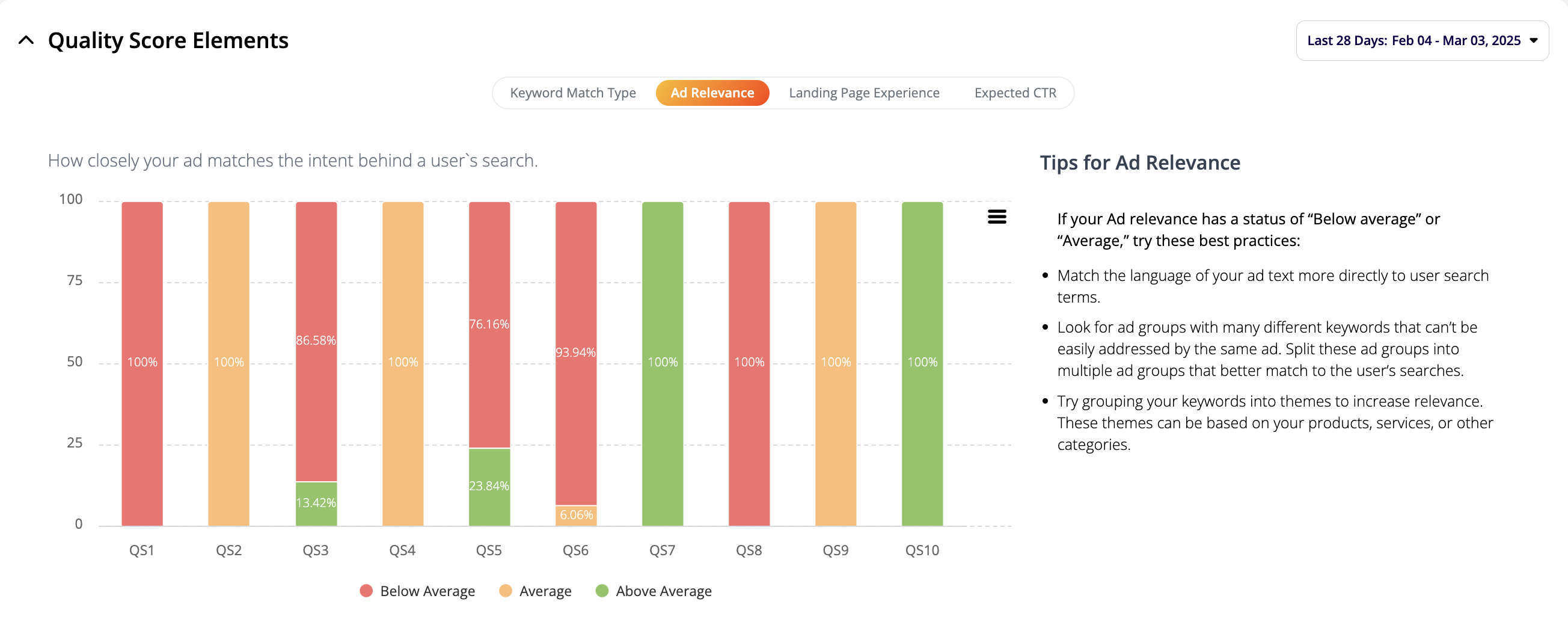
What are the three Quality Score components?
The Quality Score is calculated based on three main components: Expected Click-Through Rate (CTR), Ad Relevance, and Landing Page Experience. Each component plays a significant role in determining the overall score.
Expected Click-Through Rate (CTR):
Expected CTR is a prediction of how often your ad will be clicked when shown. This component considers the historical click-through rates of your ads and keywords. A high expected CTR indicates that your ad is likely to attract clicks, signaling relevance and appeal to users.
Ad Relevance:
Ad relevance measures how closely your ad matches the intent behind a user's search query. It assesses whether your keywords are well-aligned with your ad copy. Ensuring that your ads are tightly aligned with targeted keywords helps improve ad relevance and, consequently, your Quality Score.
Landing Page Experience:
Landing page experience evaluates the quality and relevance of your landing page. This includes factors such as page load time, mobile-friendliness, content relevance, and overall user experience. A fast, relevant landing page that is easy to use improves your landing page experience rating.
Is there more than one type of Quality Score?
Google Ads reports Quality Score at the keyword level only, with a separate rating (above average, average or below average) for expected CTR, ad relevance and landing page experience. Account, ad group and ad-level scores are not reported by Google.
Keyword-Level Quality Score: Add the Quality Score, Exp. CTR, Ad relevance and Landing page exp. columns to the Keywords table to see each keyword's score and the rating for each component.
What does a high Quality Score get you?
Achieving a high-Quality Score offers several benefits that can significantly enhance the performance and cost-effectiveness of your Google Ads campaigns:
Lower Cost Per Click (CPC): A higher Quality Score often results in lower CPCs. Google rewards well-performing ads by charging less for clicks, allowing you to get more value from your ad spend.
Better Ad Positions: Ads with higher Quality Scores are more likely to appear in top positions on the search results page. Better ad placement increases visibility and can lead to higher click-through rates and conversions.
Improved ROI: Enhanced ad performance and lower costs contribute to a better return on investment (ROI). By optimizing for Quality Score, you can achieve more efficient and effective advertising campaigns.
Increased Ad Visibility: High-Quality Scores can improve the overall visibility of your ads. When your ads are deemed highly relevant, they are more likely to be displayed prominently, reaching a larger audience.
Enhanced Competitiveness: In competitive markets, a higher Quality Score can give you an edge over competitors. It allows you to achieve better ad placements at a lower cost, making your ads more competitive.
How do you improve your Quality Score?
Improving your Quality Score means working on its three components: expected CTR, ad relevance and landing page experience. Here are some practical tips to help you boost your Quality Score:
Optimize Keywords: Conduct thorough keyword research to identify relevant terms and phrases. Use tools like Google Keyword Planner to find high-volume, low-competition keywords. Group similar keywords into tightly themed ad groups and use negative keywords to filter out irrelevant traffic.
Enhance Ad Relevance: Write compelling ad copy that closely aligns with your targeted keywords. Use clear and relevant headlines, descriptions, and calls to action. Add assets (formerly called ad extensions) such as sitelinks and callouts to give more information and lift click-through rate. Ensure that your ads address the searcher’s intent and provide a solution to their query.
Improve Landing Page Experience: Optimize your landing pages for speed, mobile-friendliness, and relevance. Make sure the content matches the intent of the keyword and the page is easy to use. Use clear headlines, relevant content, and strong calls to action. Improve page load times and ensure the landing page is easy to navigate.
Conduct A/B Tests: Regularly test different ad variations to see which perform best. Create multiple versions of your ad copy and test them against each other to identify the most effective elements. A/B testing can help you refine your ad copy and design, improving overall effectiveness and CTR.
What are common Quality Score myths?
Understanding Quality Score is essential for optimizing your Google Ads campaigns, but several misconceptions can lead to confusion. Here are some common myths and clarifications:
Myth: High CTR Guarantees a High-Quality Score
Reality: While a high click-through rate (CTR) is important, it alone does not guarantee a high Quality Score. Google also considers ad relevance and landing page experience. All three components must be optimized to achieve a high-Quality Score.
Myth: Quality Score is Static
Reality: Quality Score is dynamic and can change over time based on your ad performance and optimizations. Regularly reviewing and improving your ads, keywords, and landing pages can positively impact your Quality Score.
Myth: Keyword Match Types Significantly Impact Quality Score
Reality: While keyword match types influence how ads are triggered, Quality Score focuses more on the relevance and performance of your ads and landing pages. Ensuring that your ads and landing pages are highly relevant to the search queries is more critical than the match types alone.
Myth: Higher Ad Position Always Results in a Higher Quality Score
Reality: Ad position and Quality Score are related but not the same. A higher Quality Score can help achieve a better ad position, but the position itself does not determine the Quality Score. Focus on improving ad relevance, CTR, and landing page experience to enhance your Quality Score.
What matters most for a higher Quality Score?
Understanding and optimizing your Google Ads Quality Score is crucial for maximizing the effectiveness and efficiency of your advertising campaigns. By focusing on the key components—Expected Click-Through Rate (CTR), Ad Relevance, and Landing Page Experience—you can enhance your ad performance, lower your costs per click, and achieve better results.
Regularly monitoring your Quality Score and making necessary adjustments based on the insights provided will help you stay competitive and improve your return on investment. Implementing best practices such as optimizing keywords, enhancing ad relevance, and improving landing page experience will contribute to a higher Quality Score and more successful ad campaigns.
