A marketing team’s institutional memory is built by recording its decisions, rules, tests, and goals in one shared place over time. Teams that run ad accounts make many decisions every day about budgets, bids, targeting, and creatives. Over time, what matters is that the reasons behind those decisions are on record too.
Recording this information consistently protects institutional knowledge from being lost and lets new decisions build on past experience. When a team’s knowledge is gathered in one shared place and made accessible to both team members and AI assistants, the software world calls it a “company brain.”
Why does institutional memory matter for a marketing team?
As a team grows, so does the number of decisions made, tests run, and settings changed. How quickly the team can reach that information directly affects how fast it can move.
Atlassian’s State of Teams 2025 report, a survey of 12,000 knowledge workers and 200 executives, found that teams spend 25 percent of their working time just searching for the information they need.
Asana’s 2023 study with GWI of 9,615 workers found that 58 percent of the day goes to coordinating work rather than to skilled, strategic tasks. The workers who took part estimate they could save about 4.9 hours a week if work processes were made more efficient.
This data shows that reaching information and coordinating within the team take up a large share of the workday. Keeping information in one place and in an organized way can help teams spend less time searching and more time on decisions and strategy.
What information makes up a marketing team’s institutional memory?
A marketing team’s institutional memory can be grouped into five types of information: the rationale behind changes, test results, naming and conversion definitions, goals and thresholds, and access and tracking setup. Each type serves a different purpose for the team and is recorded in a different way.
Type of information | What it gives the team | How to structure it |
|---|---|---|
Rationale for changes (budget, bids, targeting) | Shows why a setting was changed and reduces how often the same topics are debated again | A one-line rationale note for every major change |
Test results | Shows what was tried and what was learned, so later tests are planned on earlier results | A shared list with the test name, hypothesis, and result |
Naming, UTM, and conversion definitions | Keeps reports consistent and comparable with each other | A shared document with campaign and UTM naming rules and conversion definitions |
Goals and thresholds | Makes sure “good performance” is judged the same way by everyone on the team | KPI goals and alert rules |
Access and tracking setup | Makes sure everyone who needs accounts, tags, and pixels has the access information they need | A list of account owners and the tracking setup, with at least two authorized people |
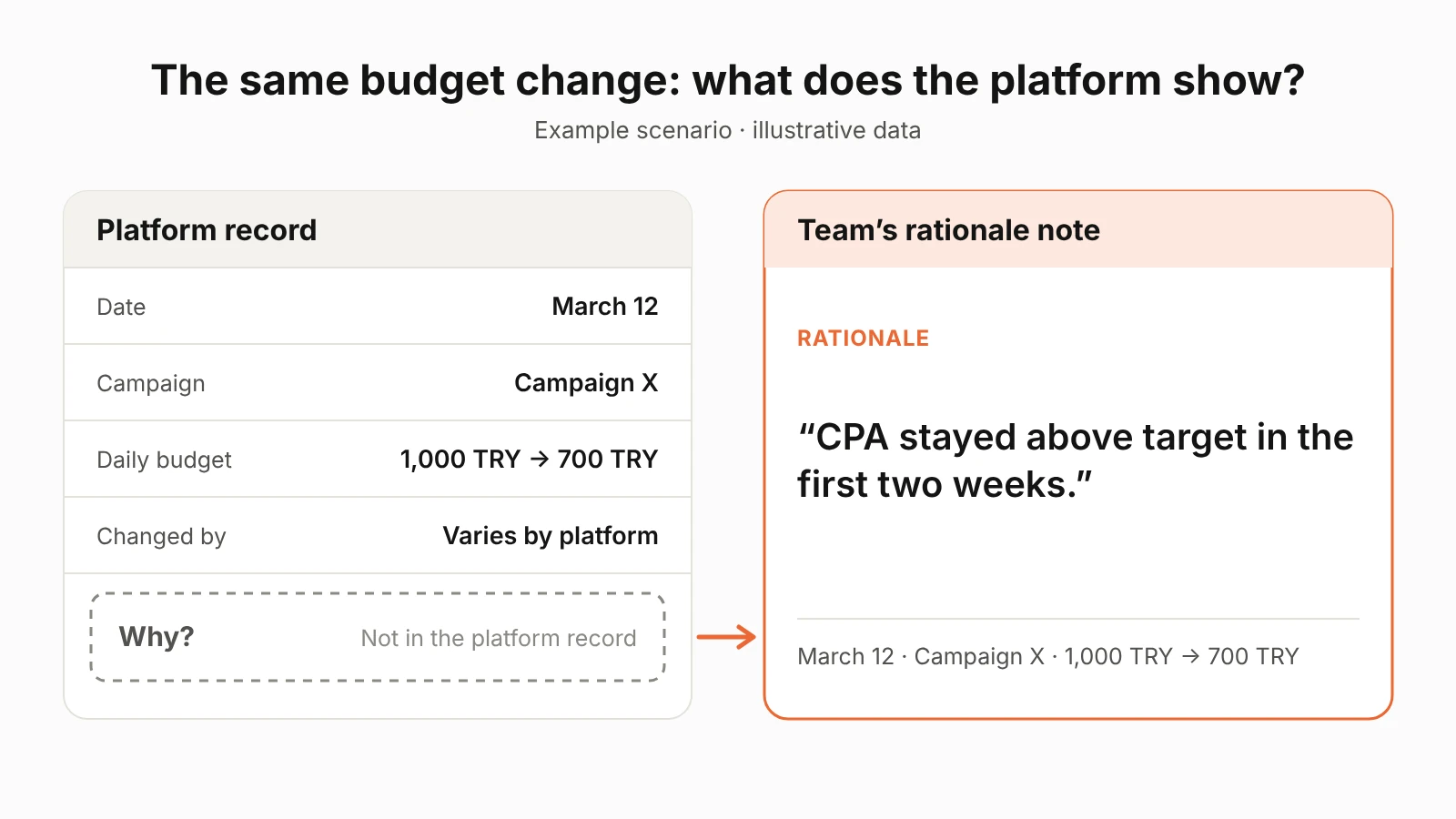
On ad platforms, you can see when a change was made, but you can’t always see the reason behind the decision. Recording that rationale separately makes it easy to understand later why a decision was made.
How do you build institutional memory in 4 steps?
Write down each decision with its rationale.
When you make a significant change to budget, bidding, or targeting, record the date, the old value, the new value, and the reason in a single line.
For example, a note like “March 12: Campaign X daily budget lowered from 1,000 TRY to 700 TRY because CPA stayed above target in the first two weeks.” is enough.
Clarify goals and thresholds.
So that “good performance” means the same thing to everyone on the team, define it with concrete KPI goals.
Orphex’s KPI tracking tool tracks KPI progress against targets and shows the trajectory within the period and the forecast for reaching the target.
In Orphex, you can receive alerts triggered by the rules you set through email, Slack, Microsoft Teams, and WhatsApp.
Collect knowledge in one place and keep it current.
Keep rationale notes, test results, and campaign and UTM naming rules in one shared place.
Assign an owner and a last-updated date to each knowledge area. This keeps outdated information from staying in use across the team.
In weekly reviews, the weekly summary in Orphex’s marketing insights tool highlights notable changes and also offers prioritized action recommendations for the coming week.
Make the knowledge usable by your AI assistant.
An AI assistant works with the written information it is given and the data it can access from the accounts it is connected to. So you can keep notes as plain text, paste them directly into the chat, or share them in a file format the assistant supports.
MCP (Model Context Protocol) is an open standard that connects AI assistants to external data sources and tools. You can connect supported AI assistants to Orphex data through MCP.
We cover which assistants are supported in our guide to MCP servers for marketing teams.
How does an AI assistant use the team’s knowledge, and who makes the decisions?
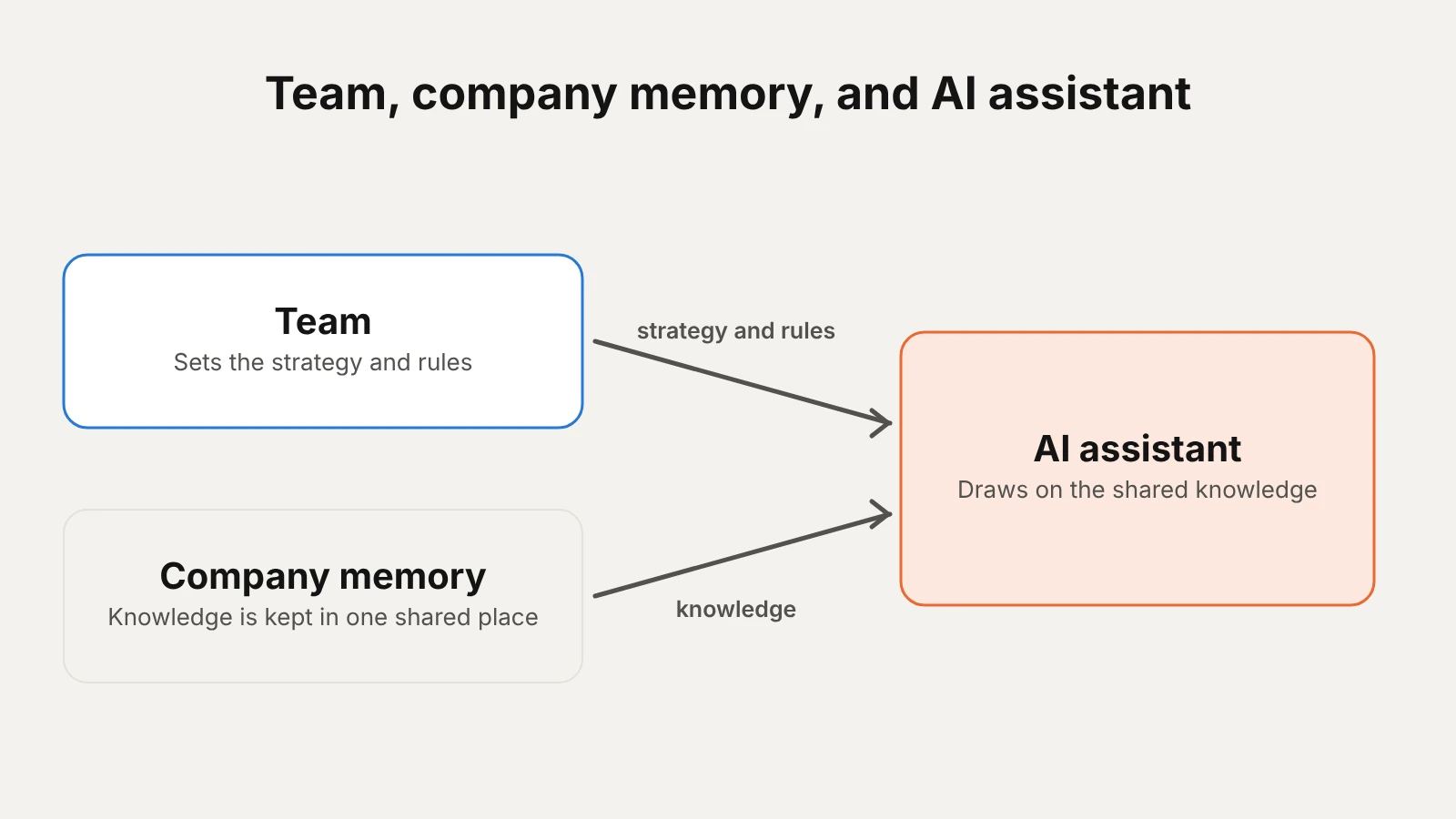
The team sets the strategy and rules. An AI assistant connected to Orphex through MCP, in turn, draws on the team’s knowledge and the data it can access.
In your connected Google Ads and Meta accounts, you can ask the assistant when a setting changed. For example, a new team member who asks, “When was this campaign’s budget last changed?” can see the date of the change, the previous value, and the new value. Through Orphex, Google Ads changes from the last 30 days can be viewed; in Meta, you can go back further.
What the platform shows about who made a change varies by platform. In Meta, the name of the person who made the change can be visible. When you look at Google Ads through Orphex, the change is shown as coming from a user, from Google, or from a connected tool, rather than with a person’s name. The reason for the change comes not from the platform record but from the rationale notes the team keeps.
As Kıvanç Ünal explained in his Slush’D Istanbul interview, it is becoming increasingly important to transfer people’s knowledge and experience into a structure that determines how AI systems work. Ünal describes this structure as a “company brain,” one that carries a company’s knowledge into the system. Institutional memory comes into play at this point: the knowledge a team builds up is kept in one shared structure, and AI can draw on it.
Frequently Asked Questions
Which changes should have their rationale written down?
Recording the rationale for significant decisions, such as budget, bidding strategy, targeting, and launching or pausing creatives, is useful. Noting every small adjustment separately can create unnecessary information overhead over time. The main rule of thumb is to write down the rationale for any change that someone might question a few months later with “Why did we do this?”
How can a new team member use institutional memory?
In the first week, a new team member can get started by reviewing the rationale notes, test results, and campaign and UTM naming rules. Reviewing the ad account alongside this information then makes it easier to understand the context behind past decisions. As gaps in the information come up along the way and get recorded, the institutional memory stays current.
Sources
Atlassian (2025), State of Teams 2025
Asana and GWI (2023), Anatomy of Work Global Index 2023
